


Reveal Heat, Relieve Pain
Handsee is a thermal and optical device, combined with ML-driven software, designed to detect signs of joint inflammation in arthritis patients.
 Watch video
1 in 4
adults
26% of adults report doctor diagnosed arthritis, with Osteoarthritis (OA) and Rheumatoid arthritis (RA) standing out as the most prevalent forms.
#1
Osteoarthritis (OA) is a leading cause of pain and disability among adults
91%
91% of osteoarthritis (OA) patients reported limitations in their everyday physical activities, with 49% reporting limitations to their work.
Why Handsee?

Trust
Patented medical device in development with HIPAA-compliant software

Technology
Highly accurate thermal and optical cameras, together with advanced ML algorithm

Instant Results
Suitable for use by healthcare providers in clinics, providing instant results

Accessibility
Simple and easy-to-use monitoring of joint inflammation of people with arthritis.
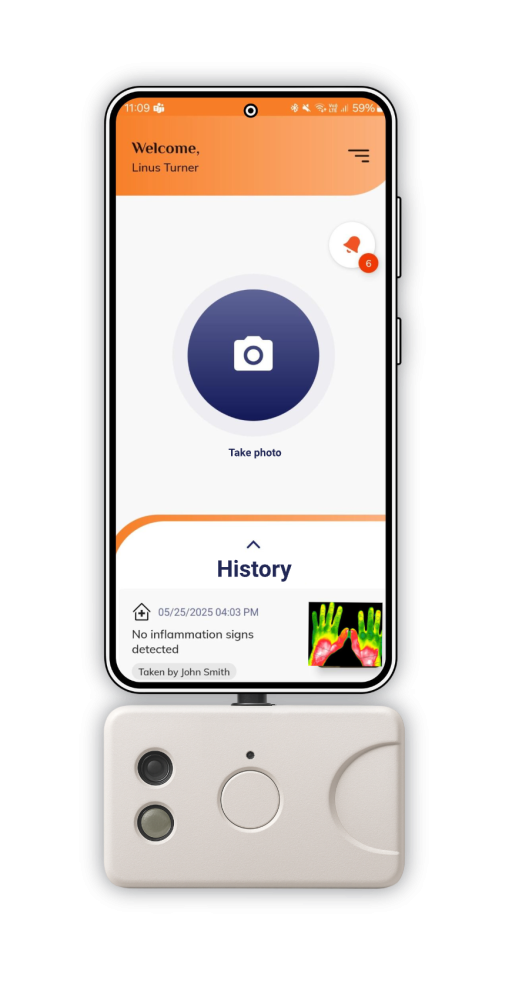
What is Handsee?
Handsee technology integrates cutting-edge thermal and optical hardware with advanced Machine Learning algorithms.
This innovative system was developed through an extensive research and development process and is being validated in clinical trials.
Included:
- Proprietary thermal and optical camera technology
- Advanced algorithms for early detection of inflamation
- Mobile app for users
- Software for healthcare providers

Secure data access and sharing with clinicians.

Real-time alerts and notifications.

Easy to view timeline of all your joints check-ups
Advantages
 | |
| Technology | Contact-less thermal and optical cameras |
| Speed of detection | Fast use ensures timely detection of inflammation |
| Accuracy | Very high, captures the thermal image without distortion |
| Ease of use | Simple, only a smartphone and Handsee camera required |
| Hygiene | Excellent, no direct contact reduces risk of contamination |
| Setup and use | Easy, quick setup, daily monitoring via app |
| Clinician autonomy | High, clinicians can use independently at clinics |
| Documentation | Automatic, real-time updates to app and physician |
Frequently Asked Questions
What is Handsee?
Handsee is a cutting-edge thermal and optical imaging device designed for early detection and monitoring of joint inflammation in patients with arthritis. By combining advanced dual-spectrum imaging (thermal + optical) with real-time AI analysis, Handsee provides clinicians with a quantitative, contactless, and rapid assessment of inflammatory activity — enabling earlier diagnosis and more effective management of arthritis.
How does Handsee work?
Handsee captures high-resolution thermal and optical images of joints using infrared sensors that detect minute variations in skin temperature — often the earliest indicators of inflammation.
Its algorithms automatically analyze these thermal patterns, quantifying inflammation levels and highlighting affected regions. This process allows healthcare professionals to detect functional changes in joint activity before structural damage becomes visible through conventional imaging.
Who can benefit from Handsee?
Handsee is intended for use by clinicians and healthcare professionals managing patients with arthritis, including rheumatoid arthritis, osteoarthritis, psoriatic arthritis, and other inflammatory joint conditions.
It is particularly beneficial for:
Rapid, objective assessments in primary care, rehabilitation centers, or rheumatology clinics.
Early detection of inflammatory activity before irreversible joint damage occurs.
Routine monitoring of disease progression and treatment response.
Is Handsee safe to use?
Yes. Handsee is a completely non-invasive and contactless imaging system. It does not emit radiation or require any physical contact with the patient. The device simply measures the natural infrared emission from the skin surface, ensuring patient comfort and minimizing infection risk.
How accurate is Handsee?
Handsee’s image analysis delivers highly reproducible and precise measurements of thermal gradients associated with inflammation. Unlike ultrasound or MRI, which depend heavily on operator expertise or detect later-stage structural changes, Handsee provides quantitative functional data in real-time.
The algorithms are continuously refined through clinical validation studies, enhancing diagnostic reliability and ensuring consistent, high-performance results across practitioners.
How long does a Handsee scan take?
A typical Handsee assessment takes less than three minutes per patient — a significant improvement over conventional imaging such as musculoskeletal ultrasound (20–40 minutes) or MRI. This efficiency supports higher clinical throughput and real-time decision-making during consultations.
Can Handsee help prevent arthritis flare-ups?
While Handsee itself does not prevent flare-ups, its ability to detect early inflammatory activity allows clinicians to intervene proactively. By identifying subtle temperature changes before symptoms escalate, physicians can adjust therapy or medication earlier, reducing the risk and severity of future flare-ups.
How should Handsee’s thermal images be interpreted?
Handsee’s clinical software generates automated, easy-to-interpret reports, including:
- Color-coded thermal maps of joint regions
- Quantitative inflammation scores
- Temporal trend analysis for follow-up visits
These insights help clinicians track disease evolution and evaluate treatment efficacy objectively over time.
Does the use of Handsee require special training?
Handsee is designed to be intuitive and user-friendly for trained healthcare professionals. Minimal training is required to perform scans, as the system automates image acquisition and interpretation. This minimizes operator dependency, ensuring consistent results across users and clinical environments.
Where can Handsee be purchased?
Handsee is being developed for deployment in clinical environments, including:
- Rehabilitation and outpatient centers
- Primary care and community clinics
- Rheumatology departments
Contact Form
We’re here to help and answer any questions you may have about Handsee. Ready to make a difference? Fill out the form below and we’ll be in touch shortly.
References:
Vitaloni M et al. BMC Musculoskeletal Disorders. 2020;21(1):1-9.